This New York Post piece on the proposed health-care surtax by Charles Hurt, David Seifman and Jennifer Fermino is really a piece of garbage. (It's ostenibly a news piece, although it comes with the slightly Dadaesque headline "DEM HEALTH RX A POI$ON PILL IN NY.") When I read propaganda about how Obama will bring us tax rates of 60% during a recession I try to remember that: (1) There is a difference between marginal and effective tax rates; and (2) None of these proposals takes effect for the next couple of years (so it is not "a scary prospect in the midst of a recession"). And let me say it again: The effective federal rate for top earners -- the rate we should care about -- will still, with this surtax, be lower than it was in the mid-90s.
Thursday, July 16, 2009
The Daily Dish | By Andrew Sullivan
Wednesday, July 15, 2009
Can The Economy Recover?������� : Information Clearing House - ICH
July 15, 2009 "Information Clearing House" -- -There is no economy left to recover. The US manufacturing economy was lost to offshoring and free trade ideology. It was replaced by a mythical “New Economy.”
The “New Economy” was based on services. Its artificial life was fed by the Federal Reserve’s artificially low interest rates, which produced a real estate bubble, and by “free market” financial deregulation, which unleashed financial gangsters to new heights of debt leverage and fraudulent financial products.
The real economy was traded away for a make-believe economy. When the make-believe economy collapsed, Americans’ wealth in their real estate, pensions, and savings collapsed dramatically while their jobs disappeared.
The debt economy caused Americans to leverage their assets. They refinanced their homes and spent the equity. They maxed out numerous credit cards. They worked as many jobs as they could find. Debt expansion and multiple family incomes kept the economy going.
And now suddenly Americans can’t borrow in order to spend. They are over their heads in debt. Jobs are disappearing. America’s consumer economy, approximately 70% of GDP, is dead. Those Americans who still have jobs are saving against the prospect of job loss. Millions are homeless. Some have moved in with family and friends; others are living in tent cities.
Meanwhile the US government’s budget deficit has jumped from $455 billion in 2008 to $2,000 billion this year, with another $2,000 billion on the books for 2010. And President Obama has intensified America’s expensive war of aggression in Afghanistan and initiated a new war in Pakistan.
There is no way for these deficits to be financed except by printing money or by further collapse in stock markets that would drive people out of equity into bonds.
The US government’s budget is 50% in the red. That means half of every dollar the federal government spends must be borrowed or printed. Because of the worldwide debacle caused by Wall Street’s financial gangsterism, the world needs its own money and hasn’t $2 trillion annually to lend to Washington.
As dollars are printed, the growing supply adds to the pressure on the dollar’s role as reserve currency. Already America’s largest creditor, China, is admonishing Washington to protect China’s investment in US debt and lobbying for a new reserve currency to replace the dollar before it collapses. According to various reports, China is spending down its holdings of US dollars by acquiring gold and stocks of raw materials and energy.
The price of one ounce gold coins is $1,000 despite efforts of the US government to hold down the gold price. How high will this price jump when the rest of the world decides that the bankruptcy of “the world’s only superpower” is at hand?
And what will happen to America’s ability to import not only oil, but also the manufactured goods on which it is import-dependent?
When the over-supplied US dollar loses the reserve currency role, the US will no longer be able to pay for its massive imports of real goods and services with pieces of paper. Overnight, shortages will appear and Americans will be poorer.
Nothing in Presidents Bush and Obama’s economic policy addresses the real issues. Instead, Goldman Sachs was bailed out, more than once. As Eliot Spitzer said, the banks made a “bloody fortune” with US aid. ...
Tuesday, July 7, 2009
dajoki's Journal - The poorest among us have increased their incomes in the last 27 years by only 16 cents per day
Published July 06, 2009 @ 06:34AM PT
http://uspoverty.change.org/blog/view/inco...
The poorest among us have increased their incomes by only $1,600 in 27 years - that's 16 cents per day.
Buried on page 15 of the National section in the NYT yesterday is coverage of a new report from the Center on Budget & Policy Priorities, demonstrating that the poorest among us - mostly jobless households with children - were not benefiting from our safety net programs (e.g., food stamps, etc.). http://www.nytimes.com/2009/07/05/us/05saf...
http://www.cbpp.org/cms/index.cfm?fa=view&...
...in 2006, the top 1 percent of households had a larger share of the nation’s after-tax income, and the middle and bottom fifths of households had smaller shares, than in any year since 1979, the first year the CBO data cover...The data reveal starkly uneven income growth over recent decades. Between 1979 and 2006, real after-tax incomes rose by 256 percent — or $863,000 — for the top 1 percent of households, compared to 21 percent — or $9,200 — for households in the middle fifth of households and 11 percent — or $1,600 — for households in the bottom fifth. (my emphases)
Sunday, July 5, 2009
Eamonn Fingleton: Detroit's Collapse: the Untold Story
In all the charges and countercharges, little of the remarkable truth of Detroit's trade problems has come out. To see how well -- or rather how badly -- you understand the background, try this quiz:
1. What was the Detroit companies' share of the Japanese market in 1930? (a) About 90 per cent. (b) About 20 per cent. (c) Less than 4 per cent.
2. How many models do the Detroit corporations currently make with the steering wheel on the right (the standard configuration for Japan)? (a) More than 40. (b) 12. (c) 3.3. What was the combined share of all foreign makers – American, European, and Japanese – in the Korean car market in the last decade? (a) Less than 2 per cent. (b) Around 15 per cent. (c) More than 70 per cent.
The correct answer in each case is (a).
If you flunked, don't feel bad. Just cancel your newspaper subscription.
... Given their well-known ability to work together in government-led cartels, Japanese corporations in particular boast a "comparative advantage" in pressurizing media ad departments.
Protected Japan
No nation has benefited more from protectionism than Japan. In recent years, however, the fact that the Japanese car market remains as protected as ever has dropped off the American press’s radar. Although Japanese officials first proclaimed the market open as far back as the 1970s, as of 2008 the combined share of all foreign makers was still just 5 per cent. This was only a fraction more than in the 1980s and the second lowest in the developed world after only Korea. ....
... Many journalists seem blind to the practical details of other nations' car industry protection tactics. What sort of tactics? Speaking in Washington in 2007, Steve Biegun, a strategist for Ford, provided some eye-opening recent Korean examples:
* Ford was barred from airing advertising commercials except between 2 a.m. and 6 a.m.* Its showrooms' floor space was restricted by government regulation.
* Korean tax officials automatically audited anyone who bought a foreign car.
Japan has used similarly disingenuous techniques in the past and indeed the tactic of hitting buyers of foreign cars with tax audits was invented in Japan.
... To be fair Tokyo has now renounced this technique. But the fact that such a stratagem persisted into the early years of this decade surely substantiates the Detroit Three's contention that Japan is hostile territory, where their products are distinctly unwelcome.
Robert Kuttner: 3 Reasons We Need an Economic Wake Up Call
The 9.5 percent official figure -- the worst since 1983 -- conceals even worse news. The number of long-term unemployed is at record levels. This is the only recession since the Great Depression in which the job loss wiped out all the job growth of the previous recovery. As our friends at the Economic Policy Institute report.
We now have fewer jobs than in May 2000 when the recovery began, though the economy now has 12.5 million more workers. And there is less than one job opening for every five people seeking jobs. Hidden unemployment is also setting records - people with part time work who want full time work, as well as people whose hours have been involuntarily cut.
...
As EPI observes, President Obama's economic stimulus simply wasn't designed for a recession this deep. And I would add that stimulus funds are getting out too slowly. Compounding the problem is inadequate government policy on three crucial fronts:
State Fiscal Collapse ...
The Foreclosure Catastrophe. ...
Busted Banks ...
Op-Ed Columnist - No Recovery in Sight - NYTimes.com
...
One of the great stories you’ll be hearing over the next couple of years will be about the large number of Americans who were forced out of work in this recession and remained unable to find gainful employment after the recession ended. We’re basically in denial about this.
There are now more than five unemployed workers for every job opening in the United States. The ranks of the poor are growing, welfare rolls are rising and young American men on a broad front are falling into an abyss of joblessness....
There were roughly seven million people officially counted as unemployed in November 2007, a month before the recession began. Now there are about 14 million. If you add to these unemployed individuals those who are working part time but would like to work full time, and those who want jobs but have become discouraged and stopped looking, you get an underutilization rate that is truly alarming.
“By May 2009,” according to the Center for Labor Market Studies at Northeastern University in Boston, “the total number of underutilized workers had increased dramatically from 15.63 million to 29.37 million — a rise of 13.7 million, or 88 percent. Nearly 30 million working-age individuals were underutilized in May 2009, the largest number in our nation’s history. The overall labor underutilization rate in May 2009 had risen to 18.2 percent, its highest value in 26 years.”Thursday, July 2, 2009
Daily Kos: State of the Nation
by Meteor Blades | Thu Jul 02, 2009 at 06:32:39 AM PDT
Unemployment rose to 9.5% in June, a 26-year high, according to the U.S. Bureau of Labor Statistics. A total of 14.7 million Americans are now officially out of work, and payroll employment has fallen by 6.5 million since the downturn began in December 2007, 19 months ago. The BLS also reported this morning that yet another 467,000 non-farm payroll jobs were lost in June. That was more than 100,000 above what a consensus of economists had estimated. Job losses in May were revised to 322,000 from an earlier estimate of 345,000.
The official count – known as U3 and dutifully reported by most of the media – fails to show the true extent of the wreckage. Left out of most reporting is U6, the BLS calculation that includes involuntarily underemployed people. That is, those who want a full-time job, but can only find part-time work. Also missing from U3 are discouraged jobless people who haven’t looked for work during the past four weeks. The U6 figure rose in June to 16.5%.
...
Companies are finding other ways to save on the aggregate labour cost bill as well, which may be a factor reinforcing the uptrend in the personal savings rate... . For example, a rapidly growing number of employers are now suspending contributions to worker 401(k) plans. According to a joint survey by CFO Research Services and Charles Schwab, nearly 25% of U.S. companies have either suspended their plans or are planning to do so (this is up from 2% at the turn of the year). Again, how we end up squeezing inflation out of the system when the labour market is clearly deflating wages and benefits for the 70% of the economy called the consumer is going to be interesting to watch. ...
...
The pair of scary charts below compare the past 40 years. The first shows a huge rise in the current recession over past years of workers who have permanently lost their jobs instead of being temporarily laid off. The second shows that for every job opening there are now nearly six people queued for it.
Digging ourselves out of the hole that 30 years of transferring wealth upward through egregious tax policies, off-shoring jobs, continuing out-of-whack defense spending, and failing to invest adequately in infrastructure and innovation is going to take better tools than we now have available to us. Will the White House and Congress provide them?
Sunday, June 7, 2009
Treasury Toxic Asset Program Rife With Conflicts Of Interest
The hiring of private firms to provide "independent" advice to both the Treasury Department and the Federal Reserve raises concerns about potential conflicts of interest, according to a letter written by the Project on Governmental Oversight (POGO) and delivered to key members of Congress.
It seems that some of those firms will be highly familiar with the assets in question.
According to POGO's letter, the Federal Reserve Board has contracted with four firms to manage its $1.25 trillion program that purchases mortgage-backed securities. One of those firms also works with the New York Fed to manage three companies it set up to absorb toxic assets, known as Maiden Lane, Maiden Lane II and Maiden Lane III.
The four firms are Pacific Investment Management Co. (PIMCO), BlackRock, Inc., Goldman Sachs Asset Management, and Wellington Management Company, LLP.
In addition, the Treasury Department is expected to approve five private firms to manage what it is calling its "Legacy Securities Program." PIMCO and BlackRock are also on that list.
Legacy appears to be the new term for "toxic." ...
Accountants, Washington Helping Banks Fluff Profits
Look for another rosy round of profits when banks turn in their numbers for the second quarter ending in June when it will be legal for them to improve their balance sheets by shifting losses into the future, thanks to new accounting rules passed by a one-vote margin by the Financial Accounting Standards Board (FASB).
It's just one in a series of changes made to accounting rules that allow banks to shift or ignore losses or pretend that liabilities aren't liabilities. The struggle for control of the financial recovery -- where the money goes, how it's counted and who survives -- is nothing short of war. Truth has been the first casualty.
The latest rule change allows banks to split losses into ones that they recognize immediately and others that are pushed down the road and may pop up on the books later. It passed in April with barely any notice from the press. The accounting tricks allow banks, which may otherwise be deemed insolvent, to continue to operate. It's a hell of a time to be an accountant. ...
U.S. manufacturing sector contracts for 16th straight month_English_Xinhua
WASHINGTON, June 1 (Xinhua) -- Economic activity in the U.S. manufacturing sector failed to grow in May for the 16th consecutive month but at a slower pace, the Institute for Supply Management (ISM) reported Monday.
...
Five of the 18 manufacturing industries reported growth last month and 13 reported contraction, according to the ISM. ...
Wednesday, June 3, 2009
How Health Care Stole Your Pay Raise - The Atlantic Business Channel
This amazing graph bouncing around the web is the most striking example of why health care reform isn't just about reforming care. It's about reforming the economy. New bumper sticker: "Reform Health Care; Get a Raise!"
In layman's terms, the hard blue line is the expected growth in average wages. The dashed-purple line is what's actually appearing in workers' wallets, which is average wages minus health premiums. In other words, health care is robbing you of your bonus. ...
Sunday, May 31, 2009
GM Chrylsler -- administration has largely ignored one of the biggest factors making them uncompetitive - the exchange rate.
For years Larry Summers and I had a running argument over industrial policy.
As a mainstream economist in good standing, he, of course argued that governments can't pick winners and losers and that even if it could, special interests would inevitably capture the process and distort it. Under no circumstances, he emphasized, should America have an industrial policy.
My view was that as an industrial nation we would inevitably make decisions that involved picking winners and losers. Breaking up AT&T, standards setting by the FCC or FDA, R&D spending by N.I.H, etc. are all examples of such decisions. The only question was and is whether those decisions would be guided by some overall productivity optimizing criteria or by chance or, more likely, the very special interests Larry feared.
Well, now that the U.S. government owns the banks, insurance, and auto companies with Larry as the chief winner and loser picker, that whole discussion has become moot.
But now that we are picking winners and losers, the question of how we are doing it has become very important. So far, the answer is "not very well."
While pouring big bucks into GM and Chrysler to keep them alive, the administration has largely ignored one of the biggest factors making them uncompetitive - the exchange rate. The strong dollar and the policies of China, Japan, Korea and others to undervalue their currencies tend to undercut the rescue effort. Industrial policy will only work if it is a complete policy, and a complete policy in this case must be one that deals with the exchange rate question. ...
Tuesday, May 26, 2009
our lawmakers is to make it easier for payday lenders, by capping their interest rates at a meager 391%.
Payday lending works like this: Some poor sap has a job and a bank account and she can’t cover his bills for the month. She’s just a bit behind on the rent or her gas bill and she needs an advance on her paycheck. ...
So, she goes to the payday lender.
Once there, she opens a line of credit. The lender agrees to give her an advance on her next paycheck and she in turn writes a check from her bank account for that amount, to the payday lender. It’s post dated and the lender agrees not to cash the check until lady’s payday. Oh, and there’s a massive fee, typically around $17 for every $100. For one payday loan, that’s not much. But it never ends there. Oh, and they don’t have to pay that fee until their next paycheck. That, of course, causes a problem on the day they get their next paycheck. It’s literally built as a trap. ...
These people become sharecroppers on their own life, giving the lender a never-ending share of their future earnings. Seventy-five percent of borrowers roll their loans over to the next week. The average borrower will pay $500 in fees for a $300 loan. Annual interest rates for payday loans average over 400 %. Consider the fees charged by one payday lender in DC as reported by The Washington Post:
If you qualify, the fee for borrowing $300 is $46.50. That was not for a year -- it's for seven days, although the terms can vary. How much interest will this payday loan cost you? In simple terms, the company is charging a $15.50 fee for every $100 that you borrow. On your $300 payday loan -- borrowed for a term of seven days -- the effective annual percentage rate is 806 percent.
...
At this time, with our distribution of wealth completely out of whack, when our usury laws need to be changed to give the poor a chance and bring stability back to our country and resurrect our manufacturing base, the response of our lawmakers is to make it easier for payday lenders, by capping their interest rates at a meager 391%.
As I said last week, we are doomed. ...
If you create a debt society by allowing insane interest rates, capital is removed from manufacturing and small business.
...
Our usury laws are insane. Our usury laws drove us into debt, sped up the loss of our manufacturing base and have directly led to the murder of the middle class. And it’s only going to get worse. The looming credit card crisis will be the next shoe to drop and with deflation a serious threat, shockingly heinous and fluctuating interest rates will make it impossible for many to get by. Even ancient Babylon had laws against the shit we allow lenders to get away with.
Usury:
1: interest
2: the lending of money with an interest charge for its use, especially: the lending of money at exorbitant interest rates.
3: an unconscionable or exorbitant rate or amount of interest; specifically: interest in excess of a legal rate charged to a borrower for the use of money.
Quite a few successful ancient empires considered usury to be worse than murder and it was punished accordingly. We, because we are an incredibly wise country, decided to toss out centuries of law and tradition. First in the early 1900’s, we began to gut our usury laws and then under Jimmy Carter they were fully disemboweled. It’s not like we didn’t have a time period to look back on and see what would happen.
800-600 B.C.
The Greeks at first regulate interest, and then deregulate it. After deregulation, there was so much unregulated debt that Athenians were sold into slavery and threatened revolt.
Slavery. Totally different from working endless hours at a job just to pay back a bank. Well, I say pay back a bank, but the amount borrowed has already been paid off tenfold. In reality, the average Joe in debt is paying off interest and more interest and more interest. It’s debt slavery and America is kicking ass.
Old Testament
The Prophet Ezekiel includes usury in a list of “abominable things,” along with rape, murder, robbery and idolatry. Ezekiel 18:19-13.
1750 B.C.
The Code of Hammurabi regulates the interest that can be charged on a loan. Historical records indicate that many loans were made below the legal limit.
What Hammurabi and Ezekiel knew, Americans certainly do not. It’s pretty simple. If you create a debt society by allowing insane interest rates, capital is removed from manufacturing and small business. It all gets pumped into the banks and everything is then out of balance. And it’s not just the money, the top minds head into the financial world, spurning the areas where society needs them, like manufacturing. Eventually it all collapses on itself. Welcome to America.
443 B.C.
The Romans adopt the “Twelve Tables” and cap interest at 8 1/3%
America has become a bunch of clowns scraping by to pay off the financial sector. We are waiters, Wal-mart workers, gas station attendants and Starbucks coffee makers, but overall, the “Financial services sector” employs most Americans directly or indirectly. We have a society built on loans. We are eating ourselves. First we started with our hands, then our arms, our legs and now we are getting into the organs. I just ate my kidneys. Not bad, I suggest grilling.
11th century
In England, the taking of any interest at all is punishable by taking the usurer’s land and chattels.
...
Medieval Roman Law
Usurer’s are fined 4X the amount taken, while robbery is penalized at twice the amount taken.
The '70s are when we decided to toss our usury laws aside and rape each other at will. The big case that turned everything upside down was Marquette National Bank v. First of Omaha Service Corp. in 1978. Before that horrible Supreme Court decision, states could set their own interest rate caps. The court ruled that banks could set their rates based on the state “where the bank is located.” No mas. Good bye interest rates under 10%. It was the wild west as far as credit card companies were concerned and we were all victims about to be fed to the pigs in Deadwood.
1570
During the Reign of Queen Elizabeth, interest rates in England are limited to under 10%. This law lasts until 1854.
American colonies adopt usury laws, setting the interest cap at 8%.
The bestest thing of all is how the banks weren’t satisfied with insane interest rates that would have led to their execution back in the day. No, they also had to go with huge overdraft fees, ATM fees, transfer fees, and on and on. And we let them. ...
After 1776
All of the States in the Union adopt a general usury. Most states set the interest limit at 6%.
...
Next week, I’ll cover payday loans, which is actually 100 times worse than credit cards.
Monday, May 25, 2009
Capitalism Produces Rich Bankers, but Socialism Produces Happiness | CommonDreams.org
Socialism is better than capitalism. So say 20 percent of Americans, and another 27 percent say they can't say which is better, according to an April 9 Rasmussen poll.
There's hope. ...
No less a "capitalist tool" than Forbes Magazine let a red cat out of the bag with a report this month that the happiest countries tend to be Scandinavian socialist democracies. High per-capita GDP certainly plays a role in their felicity, but even social democratic New Zealand, with per-capita GDP only 64 percent of the United States', ranks with the 10 democracies above us in the happiness index. They pay high taxes in these pinkotopias, but folks enjoy entitlements like free college, extensive elder care, and 52-week paid maternity leave.
... For example, our Auto Industry Task Force just bankrupted GM and Chrysler, fired tens of thousands of employees, extorted immense sacrifices from active and retired autoworkers, and is dominated by the investment bankers who absorbed trillions in national wealth to keep themselves rich after destroying the economy.
Instead of seizing plants as our Canadian comrades are doing, or adding "bossnapping" to plant occupations as the French have done, we shake our heads as the union negotiates the terms of surrender. ...
Tuesday, May 19, 2009
Computing and mathematical jobs .. down 9.3%, Engineering ... sown 10.3% [solution: more H1B to address talent shortage ?!]
Recession Comes to the Professionals
by Richard Florida
Business Week's Michael Mandel crunches the numbers and turns up some disturbing results. While recession has hit hardest at blue-collar workers, it is taking its toll on professional jobs as well. Unemployment for professionals overall increased by roughly four percent between August 2008 and April 2009. But the recession is hitting much harder at certain types of professionals. Computing and mathematical jobs (heavy on software engineers, computer scientists, and systems analysts) are down 9.3 percent; engineering and architectural jobs (two-thirds engineering) are down 10.3 percent; and "creative professional" jobs - working artists, musicians, dancers, entertainers, reporters, editors, writers, and other media types - are down 11.3 percent.
The Daily Dish | By Andrew Sullivan
Boom/Bust
Mark Thoma points to San Francisco Fed research on the lasting effects of the past decade's run-up in consumer debt and current "deleveraging" on the U.S. economy and American consumers.
U.S. household leverage, as measured by the ratio of debt to personal disposable income, increased modestly from 55% in 1960 to 65% by the mid-1980s. Then, over the next two decades, leverage proceeded to more than double, reaching an all-time high of 133% in 2007. That dramatic rise in debt was accompanied by a steady decline in the personal saving rate. The combination of higher debt and lower saving enabled personal consumption expenditures to grow faster than disposable income, providing a significant boost to U.S. economic growth over the period.
In the long-run, however, consumption cannot grow faster than income because there is an upper limit to how much debt households can service, based on their incomes.
Sunday, May 17, 2009
Obama says financial sector to shrink | Reuters
WASHINGTON (Reuters) - The financial sector will make up a smaller part of the U.S. economy in the future as new regulations clamp down on "massive risk-taking," President Barack Obama said in an interview published on Saturday.
Obama, whose young administration has spearheaded a raft of reforms in the banking sector as part of efforts to tackle the financial crisis, said the industry's role in the United States would look different at the end of the current recession.
"What I think will change, what I think was an aberration, was a situation where corporate profits in the financial sector were such a heavy part of our overall profitability over the last decade," he said told the New York Times Magazine.
"Part of that has to do with the effects of regulation that will inhibit some of the massive leveraging and the massive risk-taking that had become so common."
Obama said some of the job-seekers who may normally have gone to the financial sector would shift to other areas of the economy, such as engineering. ...
24,700,000 Unemployed or Underemployed Americans: Job Losses Accelerate with 6 million unemployed over last year. Real Unemployment rate now at 15.8
...
The fact of the matter is, when we total up all of the unemployed and underemployed we find that close to 24,700,000 Americans fall in this category.
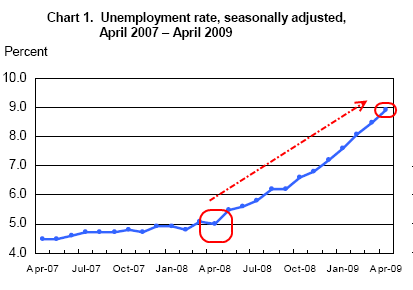
Over the past 12 months the number of unemployed has risen by 6 million. Also, if you look at the above chart, the rate has shot up by 3.9% from 5% last April of 2008 to the current 8.9%. Yet that rate is for those that are unemployed. When we start looking at the broader measure of U-6 we see that 15.8% of people are unemployed or underemployed. Let us break down the numbers:
Unemployed: 13,700,000
Part-time but looking for full-time: 8,900,000
Marginally Attached and Discouraged Workers: 2,100,000 ...
Saturday, May 9, 2009
Banks Show Clout on Legislation to Help Consumers - NYTimes.com
The banks have made it difficult for Congressional Democrats and the White House to give stretched homeowners a stronger hand in negotiating lower monthly payments on mortgages and to prevent credit card companies from imposing higher fees and interest rates.
Having won some early skirmishes by teaming with Republican allies, the banks now appear to have the upper hand and may wind up killing — or at least substantially diluting — both pro-consumer measures. ...
Saturday, May 2, 2009
Elizabeth Warren: Stress Tests Need To Be Transparent Or They're Worthless
...
"If we don't see the details of the stress test, if we don't see the complete details of the stress test, there's a real possibility no one buys any of the outcomes," said Warren, who chairs the Congressional Oversight Panel, monitoring the Troubled Asset Relief Program. "And [if no one buys the results] then we are where we are today. We are in the same place that we are without the information from the stress tests."
In an interview with the Huffington Post, the Harvard Law School Professor laid down four markers for a stable and sufficient recovery, offered support for the prosecution of individuals proven to have committed crimes that contributed to the economic downturn, and criticized bank executives for their rising compensation levels. She also insisted that if Goldman Sachs wanted to pay back the bailout funds it received to get out from under government restrictions, it should have to return all funds, including guarantees and money it receives as a counterparty to AIG.
...
"I think there's a fundamental disconnect between bankers who think its business as usual and the public that believes that when banks use hundreds of billions of taxpayer dollars things should change," she said. "A lot of the people wanted to dismiss the consumer anger over AIG and say 'Oh it's just about a tiny little slice, it doesn't matter.'... And I think its much bigger than compensation, I think its much more powerful. I think many, many people have not yet grasped this, many of the experts, the so-called experts, have not grasped the significance [of this]." ...
Tuesday, April 21, 2009
Dean Baker: Bailing out America's toxic banks won't solve this economic crisis |
While the bankers' greed fed the housing bubble, the incompetence and corruption of the economics profession allowed the world's largest financial bubble to grow unchecked, until its inevitable collapse wrecked the economy. Remarkably, the economists who got everything wrong as the bubble was expanding, are still being given the opportunity to get everything wrong as we try to dig out from the wreckage.
Even though most of the "best" economists in the world did not see it, the story of the bubble and its collapse was in fact extremely simple. The recovery from the stock market crash in 2001 was driven by the growth of the housing bubble.
...
Households spend in part based on their housing wealth. The predictable result of the creation of $8tn in housing bubble wealth ($110,000 per homeowner) was a massive consumption boom on the order of $400bn to $600bn a year. The problem was not people's spendthrift ways; the problem was that economic policymakers allowed a huge bubble to develop. People treated this bubble wealth as real wealth, and responded exactly as economic theory would predict: they spent like crazy.
...
So, if we snap our fingers and the banks are now fixed, these smaller firms will suddenly be in a position to invest more. Equipment and software investment accounts for 7% of GDP. If we generously assume that the capital-starved small firms account for half of this investment, and that the bank fix will boost their investment by 50%, then throwing money at the banks will increase investment by an amount equal to 1.75% of GDP an amount that is approximately equal to half the falloff in housing construction, and less than a quarter the total drop in demand due to the collapse of the housing bubble.
In other words, the arithmetic shows that a bank fix, while desirable, cannot possibly be sufficient to offset the collapse of the housing bubble. If our priority is to save the bankers from suffering the consequences of their own mistakes, then it makes sense to throw all our money at them. But if the point is to fix the economy, then we have to look elsewhere. ...
Monday, April 20, 2009
Federal Tax Burdens for Most Near Their Lowest Levels in Decades
Here’s a headline from the Center on Budget and Policy Priorities: Federal Tax Burdens for Most Near Their Lowest Levels in Decades. The report explains that the median-income family of four paid only 5.9 percent of its income in federal individual income taxes in 2007 (the last year for which data is available), a level that is low compared to the past 50 years. This CBPP chart says it all:
Hmmm, are the “teabaggers” crazy? Yes! Because not only are Americans paying lower taxes, they are happier with the tax system.
According to a recent Gallup Poll, “48 percent of Americans say that the amount of federal income tax they pay is ‘about right,’ with 46 percent saying ‘too high’—one of the most positive assessments Gallup has measured since 1956.” Over the past half-century, about 60 percent have usually said that taxes are “too high.”
More important than that finding, nearly two-thirds of Americans currently believe that the income tax they have to pay this year is fair.
Gallup concludes:
Gallup finds Americans' views of their federal income taxes about as positive as at any point in the last 60 years. This may reflect the income-tax cut that was part of the $787 billion economic stimulus plan, as well as a continuing sense of patriotism with the country fighting two wars.
That’s not to say that Americans like to pay taxes. They don’t. But perhaps lawmakers and the media should get a grip. There are certainly some revolting taxpayers, but politically, there is no tax revolt. ...
Chadwick: The Looming Credit Card Crisis - CNBC Guest Blog - CNBC.com
On the surface, JPMorgan Chase’s first quarter 2009 earnings look auspicious, reversing the red ink of the last few quarters and exceeding what was expected by investors.
... Today the disastrously managed credit card business threatens to be a major impediment in the economic recovery because the only way the banks can extricate themselves from the mess they have created is literally to shut down the industry. They may not view it that way, but their customers do. When you punish your best customers, the ones who pay on time and pay far over the monthly minimum, by (1) forcing them to pay higher interest rates, despite the lowest interest rates in the country in over fifty years, (2) increasing their monthly payments (3) shortening the payment terms and (4) reducing or even cancelling their credit lines, you are saying you don’t want to be in the business.
The excuse the banks are using is that the economy is difficult and everyone has to share in the pain. But who was sharing in the profits for all those years when the business was the most profitable one for the banks? Nobody but the banks reaped those rewards. They should now suffer the losses on their own.
Government involvement in industry is not good for industry or for Government. But the impact of what the banks are doing to their GOOD customers is so harmful to the economy, that it behooves the Government to open its eyes to it. It has a responsibility to its constituents. ...
Hiring H-1B Visa Workers Trims U.S. Tech Workers' Wages - by 6% ... offshoring decreases wages 2-3%
What they found is that H-1B admissions at current levels are associated with a 5% to 6% drop in wages for computer programmers, systems analysts and software engineer categories. Offshore outsourcing also decreases wages for a broader category, including IT managers, by 2% to 3%, the study found.
The IT workers most likely to be affected by the downward pressure on wages are recent college graduates and people changing jobs, the researchers said. ...
Microsoft Layoff Sparks H-1B Debate - PC World
Patrick Thibodeau, Computerworld
Feb 2, 2009 5:05 pm
Layoff announcements by IT vendors came fast and furious over the past two weeks. But it was Microsoft Corp.'s that drew the attention of a U.S. senator, who said it was "imperative" that the company give job priority to U.S. citizens over foreigners with H-1B visas.
"Microsoft has a moral obligation to protect ... American workers by putting them first during these difficult economic times," Sen. Charles Grassley (R-Iowa) wrote in a letter to Microsoft CEO Steve Ballmer on Jan. 22.
Grassley, a vocal critic of the H-1B program, could have sent the letter to any of the vendors laying off employees -- or to corporations with H-1B workers on their IT staffs. He likely singled out Microsoft because its chairman, Bill Gates, has called for an increase in the annual cap on visas during congressional hearings.
Microsoft, which plans to cut up to 5,000 employees over the next 18 months, said last week that a "significant number" of the first 1,400 people being let go are foreign workers who are in the U.S. on visas.
... But the software vendor is considered to be one of the leading H-1B employers. For instance, according to USCIS data, Microsoft received approval for a total of nearly 2,300 visas for the federal government's 2006 and 2007 fiscal years.
Most Bailed Out Banks Reduced Lending Since Getting Funds
Wall Street Journal:
Lending at the biggest U.S. banks has fallen more sharply than realized, despite government efforts to pump billions of dollars into the financial sector.
According to a Wall Street Journal analysis of Treasury Department data, the biggest recipients of taxpayer aid made or refinanced 23% less in new loans in February, the latest available data, than in October, the month the Treasury kicked off the Troubled Asset Relief Program.
Thursday, April 16, 2009
Okay, now job losses are a LOT worse than 1981-1982 :: The Curious Capitalist - TIME.com
Here, updated with this morning's non-farm payroll data from the Bureau of Labor Statistics, is the latest edition of my comparing-the-recessions chart:
Update: Now I've got a piece up on TIME.com about the employment data.
Update 2: Here's a new version of my Great Recession vs. Great Depression job loss chart.
Making Banking Boring -
|By PAUL KRUGMAN
Thirty-plus years ago, when I was a graduate student in economics, only the least ambitious of my classmates sought careers in the financial world. Even then, investment banks paid more than teaching or public service — but not that much more, and anyway, everyone knew that banking was, well, boring.
...
Recently, the economists Thomas Philippon and Ariell Reshef circulated a paper that could have been titled “The Rise and Fall of Boring Banking” (it’s actually titled “Wages and Human Capital in the U.S. Financial Industry, 1909-2006”). They show that banking in America has gone through three eras over the past century.
Before 1930, banking was an exciting industry featuring a number of larger-than-life figures, who built giant financial empires (some of which later turned out to have been based on fraud). This highflying finance sector presided over a rapid increase in debt: Household debt as a percentage of G.D.P. almost doubled between World War I and 1929.
During this first era of high finance, bankers were, on average, paid much more than their counterparts in other industries. But finance lost its glamour when the banking system collapsed during the Great Depression.
The banking industry that emerged from that collapse was tightly regulated, far less colorful than it had been before the Depression, and far less lucrative for those who ran it. Banking became boring, partly because bankers were so conservative about lending: Household debt, which had fallen sharply as a percentage of G.D.P. during the Depression and World War II, stayed far below pre-1930s levels.
Strange to say, this era of boring banking was also an era of spectacular economic progress for most Americans.
After 1980, however, as the political winds shifted, many of the regulations on banks were lifted — and banking became exciting again. Debt began rising rapidly, eventually reaching just about the same level relative to G.D.P. as in 1929. And the financial industry exploded in size. By the middle of this decade, it accounted for a third of corporate profits. ......
Part of the problem is that boring banking would mean poorer bankers, and the financial industry still has a lot of friends in high places. But it’s also a matter of ideology: Despite everything that has happened, most people in positions of power still associate fancy finance with economic progress. ...
Mike Whitney: "Liquidate the Banks; Fire the Executives!"
On Tuesday, a congressional panel headed by ex-Harvard law professor Elizabeth Warren released a report on Treasury Secretary Timothy Geithner's handling of the Troubled Assets Relief Program (TARP). Warren was appointed to lead the five-member Congressional Oversight Panel (COP) in November by Senate majority leader Harry Reid. From the opening paragraph on, the Warren report makes clear that Congress is frustrated with Geithner's so-called "Financial Rescue Plan" and doesn't have the foggiest idea of what he is trying to do. Here are the first few lines of "Assessing Treasury's Strategy: Six Months of TARP":
"With this report, the Congressional Oversight Panel examines Treasury’s current strategy and evaluates the progress it has achieved thus far. This report returns the Panel’s inquiry to a central question raised in its first report: What is Treasury’s strategy?"
Six months and $1 trillion later, and Congress still cannot figure out what Geithner is up to. It's a wonder the Treasury Secretary hasn't been fired already.
From the report:
"In addition to drawing on the $700 billion allocated to Treasury under the Emergency Economic Stabilization Act (EESA), economic stabilization efforts have depended heavily on the use of the Federal Reserve Board’s balance sheet. This approach has permitted Treasury to leverage TARP funds well beyond the funds appropriated by Congress. Thus, while Treasury has spent or committed $590.4 billion of TARP funds, according to Panel estimates, the Federal Reserve Board has expanded its balance sheet by more than $1.5 trillion in loans and purchases of government-sponsored enterprise (GSE) securities. The total value of all direct spending, loans and guarantees provided to date in conjunction with the federal government’s financial stability efforts (including those of the Federal Deposit Insurance Corporation (FDIC) as well as Treasury and the Federal Reserve Board) now exceeds $4 trillion."
So, while Congress approved a mere $700 billion in emergency funding for the TARP, Geithner and Bernanke deftly sidestepped the public opposition to more bailouts and shoveled another $3.3 trillion through the back door via loans and leverage for crappy mortgage paper that will never regain its value. Additionally, the Fed has made a deal with Treasury that when the financial crisis finally subsides, Treasury will assume the Fed's obligations vis a vis the "lending facilities", which means the taxpayer will then be responsible for unknown trillions in withering investments. ...
TARP banks rescue: designers plans are “either in the pocket of the banks or they’re incompetent.”
April 16 (Bloomberg) -- The Obama administration’s plan to fix the U.S. banking system is destined to fail because the programs have been designed to help Wall Street rather than create a viable financial system, Nobel Prize-winning economist Joseph Stiglitz said.
“All the ingredients they have so far are weak, and there are several missing ingredients,” Stiglitz said in an interview. The people who designed the plans are “either in the pocket of the banks or they’re incompetent.”
The Troubled Asset Relief Program, or TARP, isn’t large enough to recapitalize the banking system, and the administration hasn’t been direct in addressing that shortfall, he said. Stiglitz said there are conflicts of interest at the White House because some of Obama’s advisers have close ties to Wall Street.
“We don’t have enough money, they don’t want to go back to Congress, and they don’t want to do it in an open way and they don’t want to get control” of the banks, a set of constraints that will guarantee failure, Stiglitz said.
The return to taxpayers from the TARP is as low as 25 cents on the dollar, he said. “The bank restructuring has been an absolute mess.” ...
Tuesday, April 7, 2009
The Credit Card Trap - NYTimes.com
...
As the credit card business boomed in recent years, too many lenders added tricks and traps that have ensnared and infuriated millions of their customers. Interest rates spike even when a consumer meticulously pays on time. Fees appear out of nowhere; banks can change their complicated rules at any time or for any reason.
Responding to thousands of complaints, the Federal Reserve Board issued new rules last December to help curb unfair and deceptive practices. But those protections will not take effect until July of next year. [July 2010!..ed.] Congress now has an opportunity to move far more swiftly.
Senator Christopher Dodd, a Democrat from Connecticut and chairman of the Senate banking committee, has offered a credit card bill that deserves the support of his colleagues. It is stronger than the Fed’s regulations and would provide consumers relief more quickly than the credit card bill now moving through the House.
The Dodd bill would help end “bait and switch” tactics like promising a very low interest rate then adding hidden fees and other charges. It would make credit card contracts, which tend to favor the banks, less one-sided. It would help protect younger customers who are more easily tricked into burdensome debt.
And it would provide stronger protection against abusive practices — charging very high fees, for instance, for minor mistakes like being hours late paying the bill. ...Thursday, April 2, 2009
Geithner's Five Big Misconceptions
...
In our opinion, because Tim Geithner formed his view of this crisis last fall, while sitting across the table from his constituents at the New York Fed: The CEOs of the big Wall Street firms. He views the crisis the same way Wall Street does--as a temporary liquidity problem--and his plans to fix it are designed with the best interests of Wall Street in mind.
If Geithner's plan to fix the banks would also fix the economy, this would be tolerable. But no smart economist we know of thinks that it will.
We think Geithner is suffering from five fundamental misconceptions about what is wrong with the economy. Here they are:
The trouble with the economy is that the banks aren't lending. The reality: The economy is in trouble because American consumers and businesses took on way too much debt and are now collapsing under the weight of it. ...The banks aren't lending because their balance sheets are loaded with "bad assets" that the market has temporarily mispriced. The reality: The banks aren't lending (much) because they have decided to stop making loans to people and companies who can't pay them back. ...
Bad assets are "bad" because the market doesn't understand how much they are really worth. The reality: The bad assets are bad because they are worth less than the banks say they are. House prices have dropped by nearly 30% nationwide. That has created something in the neighborhood of $5+ trillion of losses in residential real estate alone ...
Once we get the "bad assets" off bank balance sheets, the banks will start lending again. The reality: The banks will remain cautious about lending, because the housing market and economy are still deteriorating. ...
Once the banks start lending, the economy will recover. The reality: American consumers still have debt coming out of their ears, and they'll be working it off for years. ...
...
... The two charts below from Ned Davis illustrate the real problem: An explosion of debt relative to GDP. The first is Nonfinancial Debt To GDP. The second is Total Debt To GDP.
In Geithner's plan, this debt won't disappear. It will just be passed from banks to taxpayers, where it will sit until the government finally admits that a major portion of it will never be paid back.
...