Tuesday, November 10, 2009

OpEdNews - Article: One Reason that the Stock Market is Rising While Unemployment is Soaring

OpEdNews - Article: One Reason that the Stock Market is Rising While Unemployment is Soaring

Daniel Gross points out that part of the reason that the American stock markets are going up even though unemployment is rising and the real economy suffering is because multinational corporations headquartered in the U.S. are experiencing strong sales abroad:

Here's a puzzle: The stock markets are doing very well, yet the performance of the underlying economy doesn't seem to justify optimism. The buoyant S&P 500 has risen 53 percent since the March bottom. And while the economy expanded at a 3.5 percent rate in the third quarter, unemployment is high, incomes are stagnant, and consumers are shaky...

It could be that the notion the stock market is an accurate gauge of the domestic economy's temperature is outdated.

The Dow, the S&P 500, and the NASDAQ are primarily indices of large U.S.-based companies, not main street businesses: more Davos than Chamber of Commerce. These increasingly cosmopolitan firms have been busy globalizing and expanding their operations overseas. In 2006, according to Standard & Poor's, 238 members of the S&P 500 broke out revenues between U.S. and non-U.S. sales. These companies notched about 43.6 percent of sales outside the United States. For large companies that had already saturated the U.S. market, the home market was something of an afterthought. In the second quarter of 2007, 66 percent of Coca-Cola's beverage business came from outside North America.

...

The fact that companies based in America are raking in profits from sales abroad is good for American workers, right?

No.

Gross points out that American workers don't benefit because a lot of the goods sold abroad by American multinationals are made abroad:

If companies participated in foreign markets primarily by exporting U.S.-made goods, this shift would be good news for the U.S. economy and workers. But that's not how it works. In fact, in the months after the global credit meltdown, U.S. exports plummeted. They bottomed in April, at $120.6 billion, and though they have been rising, the August 2009 total is still 20 percent below the August 2008 total. Globalization is changing the way we do business. It's not a matter of U.S. companies exporting goods—burgers, soda, cars, software—made in the United States to Beijing but rather, making goods overseas and selling them overseas...

"Based on a Russian fairy tale and produced in Russia using local talent, the film is the latest step in Disney's broad push into local language production," the FT reports. As Disney CEO Robert Iger put it: "We would not be able to grow the Disney brand " if we just created product in the US and exported it to the rest of the world." If Book of Masters succeeds, it will be good for Disney's American shareholders but won't do a whole lot of good for its U.S.-based employees. Or consider American icon General Motors. GM's sales in China are rocking. In the first nine months, the company sold 1.3 million cars in China, including more than 181,000 in September. By contrast, GM in the United States in the first nine months sold 1.5 million cars in the United States, down 36.4 percent from the year before. And in September, GM sold just 156,673 cars in the United States. That growth in China is good for GM's shareholders and for some of its executives. But since most of the cars sold in China are produced there, with parts produced by suppliers in China, rising sales in the Middle Kingdom won't translate into jobs for unionized workers in the Middle West.

...

Well, at least the multinationals are paying a good chunk of taxes into the American economy, right?

Not exactly.

The Washington Post notes:

About two-thirds of corporations operating in the United States did not pay taxes annually from 1998 to 2005, according to a new report scheduled to be made public today from the U.S. Government Accountability Office...

In 2005, about 28 percent of large corporations paid no taxes...

Dorgan and Sen. Carl M. Levin (D-Mich.) requested the report out of concern that some corporations were using "transfer pricing" to reduce their tax bills. The practice allows multi-national companies to transfer goods and assets between internal divisions so they can record income in a jurisdiction with low tax rates...

[Senator] Levin said: "This report makes clear that too many corporations are using tax trickery to send their profits overseas and avoid paying their fair share in the United States."

Indeed, as Pulitzer prize winning journalist David Cay Johnston documents, American multinationals pay much less in taxes than they should through a variety of widespread schemes, including:

  • Selling valuable assets of the American companies to foreign subsidiaries based in tax havens for next to nothing, so that those valuable assets can be taxed at much lower foreign rates
  • Pretending that costs were spent in the United States, so that the companies can count them as costs or deductions in the U.S. and pay less taxes to the American government
  • Booking profits as if they occurred in the subsidiary's tax haven countries, so that taxes paid on profits are at the much lower safe haven rate
  • Working out sweetheart deals with certain foreign governments, so that the companies can pretend they paid more in foreign taxes than they actually did, to obtain higher U.S. tax credits than are warranted
  • Pretending they are headquartered in tax havens like Bermuda, the Cayman Islands or Panama, so that they can enjoy all of the benefits of actually being based in America (including the use of American law and the court system, listing on the Dow, etc.), with the tax benefits associated with having a principal address in a sunny tax haven.
  • And myriad other scams
As Johnston documents, the American economy is hurt by the massive underpayment of taxes by the huge multinationals.

On a New Form of Indentured Servitude � The Confluence

On a New Form of Indentured Servitude � The Confluence

There’s so much going on in the USA that warrants attention these days that it’s hard to know where to start. But, since I’m an economist I’m going to start here.

“There are families not eating at the end of the month,” said Stephen Quinn, executive vice president and chief marketing officer at Wal-Mart Stores, and “literally lining up at midnight” at Wal-Mart stores waiting to buy food when paychecks or government checks land in their accounts.

Among the steps Wal-Mart is taking to address the changes in shopping habits, Mr. Quinn listed an overhaul of the retailer’s private-label brand, Great Value, which is promoted in commercials describing how families can fix dinners with Great Value products “for less than $2 a serving.”

The really sad thing about this blurb is that I got it from the Media & Advertising section of the NY Times. It did not come from the op-ed page, it did not come from the business section nor the politics section. It’s there because Walmart is having to work on its product mix to reflect hunger in those families living below the poverty living in one of the richest countries in the world –The United States–and I am deeply ashamed as a citizen of that country to read this anywhere STILL after all these years.

There’s been an academic discussion about the disconnect between what some of our nation’s statistics tell us is going on and the reality on the ground. There was a conference this weekend to talk about re-working the way the nation calculates its GDP. This is extremely important. Because of globalization, we are most likely over stating our performance in way that is throwing off our policy targets. We are losing per capita income from the lowest to middle quintiles and we are hemorrhaging well-paying jobs for our most vulnerable citizens. They are not able to get enough to live on and they are not wealthy enough to buy health care insurance or to pay premium taxes to feed an already over-bloated, costly, and inefficient industry. ...

Thursday, November 5, 2009

Unemployment rate expected to hit 9.9% - MarketWatch

Unemployment rate expected to hit 9.9% - MarketWatch
..

The unemployment rate likely rose by a tenth of a percentage point to 9.9%, which would be the highest in 26 years. Some analysts are predicting a 10% or even a 10.1% jobless rate in October.

The faint silver lining is that, according to the survey of economists conducted by MarketWatch, seasonally adjusted payroll losses are projected to decline from 263,000 in September to just 150,000 in October, which would be the fewest jobs lost since July 2008. At its worst point, the economy was shedding about 700,000 jobs a month.

So far during the recession, a total of 7.2 million jobs have been lost, including 5.8 million in the past year. One in 20 private-sector jobs have disappeared.

As grim as those numbers are, they likely understate the number of jobs lost by about 800,000, according to the preliminary estimate for the annual benchmark based on tax records.

...

Wednesday, November 4, 2009

Editorial - Some Sense on Defense Spending - NYTimes.com

Editorial - Some Sense on Defense Spending - NYTimes.com

Presidents, and those aspiring to be presidents, routinely promise to reform the defense procurement process. And defense contractors, their lobbyists and the military services routinely ensure that never happens.

This year has been refreshingly different. President Obama and his defense secretary, Robert Gates, have made a compelling case for ending weapons programs that significantly exceed their budgets or use limited tax dollars to buy more capability than the nation needs. And Congress has agreed — somewhat.

The $680 billion defense authorization bill signed into law by President Obama last week pares back or cancels billions of dollars in expensive weapons systems that are either anachronistic, redundant, poorly performing or exceed the military’s real requirements. Even with these reductions, the defense bill is one of the biggest in history, in part because of the continuing wars in Iraq and Afghanistan. But it sets an important base line for future cuts that need to be far more ambitious. ...

... The biggest political win was ending production of the Air Force’s F-22 stealth fighter jet after 187 aircraft. Several previous presidents, including President George W. Bush, tried and failed to end the program. The decision by Lockheed Martin and its partners to put plants and other facilities in dozens of states ensured that it had a lot of powerful friends on Capitol Hill.

This time, strategic reality finally trumped high-priced lobbyists. The F-22 was designed for combat against the former Soviet Union and has not been used in Iraq or Afghanistan. The Air Force’s new high-performance F-35 Joint Strike Fighter, a Lockheed Martin weapon that begins production in 2012, should be sufficient. ...

Monday, November 2, 2009

Soros Launches Effort to Battle Free-Market Zeal | Newsweek Voices - Michael Hirsh | Newsweek.com

Soros Launches Effort to Battle Free-Market Zeal | Newsweek Voices - Michael Hirsh | Newsweek.com

"Large swaths of economics are going to have to be rethought on the basis of what's happened." So said Larry Summers, President Obama's chief economic adviser, in an interview in the weeks after the markets crashed a year ago. Yet to a remarkable degree, economic thinking hasn't changed very much at all. (Click here to follow Michael Hirsh).

Now financier George Soros is announcing a $50 million effort to speed things along. This week Soros is gathering some of the leading practitioners of the market-skeptic school, who were marginalized during the era of "free-market fundamentalism," among them Nobelists Joseph Stiglitz, George Akerlof, Michael Spence, and Sir James Mirrlees. He's also creating an "Institute for New Economic Thinking" to make research grants, convene symposiums, and establish a journal, all in an effort to take back the economics profession from the champions of free-market zealotry who have dominated it for decades, and to correct the failures of decades of market deregulation. Soros hopes matching funds will bring the total endowment up to $200 million. "Economics has failed not only to predict and explain what happened but has also failed to protect society," says Robert Johnson, a former managing director at Soros Fund Management, who will direct the new institute. "That's what the crisis revealed. The paradigm has failed. There is no guidance."

It might be tempting to dismiss all this as a war of words among brainiacs. It's not. The critical issues being discussed in Washington about the future regulation and control of the financial industry—the very nature of Wall Street and the health of the economy—depend on this battle of ideas. What led to wholesale deregulation in the '90s and '00s wasn't just Wall Street lobbying money. It was also that key legislators and policymakers, among them Larry Summers, persuaded themselves that deregulation was sound economics and good policy, and that markets and Wall Street institutions could take care of themselves. Many of those views have been discredited by the crisis. But in the absence of a new paradigm of economics, confusion still reigns in Washington. With no new concept of the proper role of government and regulation in the economy, of the proper balance between the markets and their minders, the old school still dominates.

And some of the economists whose work was most prescient, and most ignored, remain marginalized.

Exhibit No. 1: the late Hyman Minsky, a bushy-haired dissident at the University of California, Berkeley, and Washington University who saw into the heart of financial-market mania perhaps more deeply than anyone else. Minsky's "Financial Instability Hypothesis," which he developed in the '60s, held that success in financial markets always breeds its own instability. The longer a boom lasts, the less market players consider failure a possibility; as a result, careful borrowing, lending, and investment inevitably give way to recklessness and speculative euphoria. Margins and capital cushions come to be seen as unnecessary. At a certain watershed point—sometimes called a "Minsky moment"—the foreordained collapse begins. The most speculative bets crash, loans are called in, asset values plunge, and the downward spiral feeds on itself. That's what happened over the last two years.

Minsky was in effect filling in many of the intellectual blanks left by John Maynard Keynes on the critical question of how financial markets affect the "real" economy. Nonetheless, an assessment of Minsky in 1997, a year after he died, concluded that his "work has not had a major influence in the macroeconomic discussions of the last thirty years." Since the current crash, Minsky has been rediscovered by economic pundits, and now a few economists are struggling to turn his insights into a model of how the economy really works. ...

Food Stamps Will Feed Half Of US Kids, Study Says

Food Stamps Will Feed Half Of US Kids, Study Says

CHICAGO — Nearly half of all U.S. children and 90 percent of black youngsters will be on food stamps at some point during childhood, and fallout from the current recession could push those numbers even higher, researchers say.

The estimate comes from an analysis of 30 years of national data, and it bolsters other recent evidence on the pervasiveness of youngsters at economic risk. It suggests that almost everyone knows a family who has received food stamps, or will in the future, said lead author Mark Rank, a sociologist at Washington University in St. Louis.

"Your neighbor may be using some of these programs but it's not the kind of thing people want to talk about," Rank said. ...

Growing Unequal? Income Distribution and Poverty in OECD Countries

Growing Unequal? Income Distribution and Poverty in OECD Countries

Growing Unequal? brings together a range of analyses on the distribution of economic resources in OECD countries. The evidence on income distribution and poverty covers, for the first time, all 30 OECD countries in the mid-2000s, while information on trends extending back to the mid-1980s is provided for around two-thirds of the countries.

The report also describes inequalities in a range of domains (such as household wealth, consumption patterns, in-kind public services) that are typically excluded from conventional discussion about the distribution of economic resources among individuals and households. Precisely how much inequality there is in a society is not determined randomly, nor is it beyond the power of governments to change, so long as they take note of the sort of up-to-date evidence included in this report.

...

Did You Know ? (income inequality)

The gap between rich and poor and the number of people below the poverty line have both grown over the past two decades. The increase is widespread, affecting three-quarters of OECD countries. The scale of the change is moderate but significant.

[Table 11.1. Summary of changes in income inequality and poverty]

Income inequality increased significantly in the early 2000s in Canada, Germany, Norway and the United States. But incomes in Greece, Mexico and the United Kingdom became more equal.

[Figure 1.1. Gini coefficients of income inequality in OECD countries, mid-2000s]

[Figure 1.2. Trends in income inequality]

The rise in inequality is generally due to the rich improving their incomes relative both to low- and middle-income people.

[Table 1.1. and Table 1.2. Trends in real household income by quintiles, Gains and losses of income shares by income quintiles]


Income Distribution and Poverty data
in Gapminder Graphs

Go to Gapminder application


The Gapminder Graphs allow you to unveil the interactions between income Distribution and Poverty data over time.

�� Are You Ready for the Next Crisis?������ : Information Clearing House - ICH

Are You Ready for the Next Crisis? : Information Clearing House - ICH

October 26, 2009 "Information Clearing House" -- Evidence that the US is a failed state is piling up faster than I can record it.
One conclusive hallmark of a failed state is that the crooks are inside the government, using government to protect and to advance their private interests.

...
Another conclusive hallmark is rising income inequality as the insiders manipulate economic policy for their enrichment at the expense of everyone else.
Income inequality in the US is now the most extreme of all countries. The 2008 OECD report, “Income Distribution and Poverty in OECD Countries,” concludes that the US is the country with the highest inequality and poverty rate across the OECD and that since 2000 nowhere has there been such a stark rise in income inequality as in the US.

The OECD finds that in the US the distribution of wealth is even more unequal than the distribution of income.

On October 21, 2009, Business Week reported that a new report from the United Nations Development Program concluded that the US ranked third among states with the worst income inequality. As number one and number two, Hong Kong and Singapore, are both essentially city states, not countries, the US actually has the shame of being the country with the most inequality in the distribution of income.
The stark increase in US income inequality in the 21st century coincides with the offshoring of US jobs, which enriched executives with “performance bonuses” while impoverishing the middle class, and with the rapid rise of unregulated OTC derivatives, which enriched Wall Street and the financial sector at the expense of everyone else.

Millions of Americans have lost their homes and half of their retirement savings while being loaded up with government debt to bail out the banksters who created the derivative crisis.

Frontline’s October 21 broadcast, “The Warning,” documents how Federal Reserve Chairman Alan Greenspan, Treasury Secretary Robert Rubin, Deputy Treasury Secretary Larry Summers, and Securities and Exchange Commission Chairman Arthur Levitt blocked Brooksley Born, head of the Commodity Futures Trading Commission, from performing her statutory duties and regulating OTC derivatives.
After the worst crisis in US financial history struck, just as Brooksley Born said it would, a disgraced Alan Greenspan was summoned out of retirement to explain to Congress his unequivocal assurances that no regulation of derivatives was necessary. Greenspan had even told Congress that regulation of derivatives would be harmful. A pathetic Greenspan had to admit that the free market ideology on which he had relied turned out to have a flaw.
Greenspan may have bet our country on his free market ideology, but does anyone believe that Rubin and Summers were doing anything other than protecting the enormous fraud-based profits that derivatives were bringing Wall Street? As Brooksley Born stressed, OTC derivatives are a “dark market.” There is no transparency. Regulators have no information on them and neither do purchasers.
Even after Long Term Capital Management blew up in 1998 and had to be bailed out, Greenspan, Rubin, and Summers stuck to their guns. Greenspan, Rubin and Summers, and a roped-in gullible Arthur Levitt who now regrets that he was the banksters’ dupe, succeeded in manipulating a totally ignorant Congress into blocking the CFTC from doing its mandated job. ...

G-20 Manufacturing: A Look At The Numbers | OurFuture.org

G-20 Manufacturing: A Look At The Numbers | OurFuture.org

It's fairly common to refer to the world's wealthier nations as industrialized nations, though with the advent of outsourcing and widespread export-oriented development strategies, that term isn't as precise as it used to be. Then even if it were precise, discussions of global economic issues often involve numbers that we're ill-prepared to digest and have little to compare to; all the numbers just sound ridiculously large. This is an attempt to quantify industrialization and break it down for comparison among the 20 largest national economies.
...
A policy solution focused on boosting wages for the general world population might create enough demand to reverse that trend in declining manufacturing employment. Though in the current recession that seems unlikely. A U.S. Census Bureau report indicates that median U.S. income dropped 3.6 percent from 2007-2008, suggesting that a decline in consumer spending power was in full swing before the financial meltdown and subsequent tightening of the credit markets.
...
G20 (w/o EU, +Iran) Population* 2008 GDP** 2008 Mfg output** Mfg:Population Mfg:GDP
Germany 82,140,000 3,649,468,713,255 767,173,986,290 9,340 21%
Japan 127,704,000 4,910,691,611,512 1,044,573,591,840 8,180 21%
Italy 59,855,000 2,303,058,798,157 381,043,924,161 6,366 17%
United States 304,060,000 14,096,716,929,022 1,830,682,964,800 6,021 13%
Canada 33,311,000 1,502,198,148,431 195,141,329,938 5,858 13%
United Kingdom 61,399,000 2,666,266,099,179 323,014,231,511 5,261 12%
France 62,048,000 2,856,528,838,542 306,279,105,638 4,936 11%
South Korea 48,607,000 929,123,721,319 230,763,192,037 4,748 25%
Australia 21,374,000 1,016,897,316,528 100,814,383,824 4,717 10%
Mexico 106,350,000 1,081,683,289,858 196,798,970,122 1,850 18%
Russian Federation 141,800,000 1,676,587,800,343 256,176,482,781 1,807 15%
Argentina 39,876,000 333,322,390,163 70,904,305,110 1,778 21%
Turkey 73,914,000 741,448,415,136 117,362,508,155 1,588 16%
Saudi Arabia 24,646,000 467,600,800,000 38,736,800,000 1,572 8%
Brazil 191,972,000 1,595,497,752,838 237,337,404,166 1,236 15%
China~ 1,325,640,000 4,327,024,438,542 1,399,427,894,063 1,056 32%
South Africa 48,687,000 276,445,740,280 46,691,753,078 959 17%
Indonesia 228,249,000 510,779,261,184 139,528,690,939 611 27%
Iran 71,956,000 346,611,390,279 36,510,371,841 507 11%
India 1,139,965,000 1,253,859,848,115 188,135,054,712 165 15%

Resources

* - 2008 population data (pdf); World Bank figures
** - 2008 GDP and Manufacturing output in current US dollars; United Nations figures
~ - UN manufacturing data for China isn't separated out from mining and utilities, used a 78% multiplier on the UN-supplied figure.

One in six Americans in poverty, new study finds | Raw Story

One in six Americans in poverty, new study finds | Raw Story

The level of poverty in America is even worse than first believed.

A revised formula for calculating medical costs and geographic variations show that approximately 47.4 million Americans last year lived in poverty, 7 million more than the government's official figure.

...

The NAS formula shows the poverty rate to be at 15.8 percent, or nearly 1 in 6 Americans, according to calculations released this week. That's higher than the 13.2 percent, or 39.8 million, figure made available recently under the original government formula. ...

* About 18.7 percent of Americans 65 and older, or nearly 7.1 million, are in poverty compared to 9.7 percent, or 3.7 million, under the traditional measure. That's due to out-of-pocket expenses from rising Medicare premiums, deductibles and a coverage gap in the prescription drug benefit.

* About 14.3 percent of people 18 to 64, or 27 million, are in poverty, compared to 11.7 percent under the traditional measure. Many of the additional poor are low-income, working people with transportation and child-care costs.

* Child poverty is lower, at about 17.9 percent, or roughly 13.3 million, compared to 19 percent under the traditional measure. That's because single mothers and their children disproportionately receive non-cash aid such as food stamps.

One Nation, Under Illusion : Information Clearing House - ICH

One Nation, Under Illusion : Information Clearing House - ICH

October 13, 2009 "" -- -The hoariest and most oft-repeated cliche in American politics may be that America is the greatest country in the world. Every politician, Democrat and Republican, seems duty bound to pander to this idea of American exceptionalism, and woe unto him who hints otherwise. This country is "the last, best hope of mankind,'' or the "shining city on the hill,'' or the "great social experiment.'' As if this weren't enough, Jimmy Carter upped the fawning ante 30 years ago by uttering arguably the most damning words in modern American politics. He called for a "government as good as the American people,'' thus taking national greatness and investing it in each and every one of us.
...
In the end, government has inspired Americans far more than Americans have inspired their government. They are too busy boasting.

There is nothing wrong with self-satisfaction or national pride. But the incessant trumpeting of our national superiority to every other country in the world is more than just off-putting and insulting. It is infantile, like the vaunting of a schoolyard bully that his Dad is better than your Dad. It is wrong. And it might be dangerous both to ourselves and to the rest of the world.

Consider what it means. By what standard is one nation any greater than any other nation? Yes, the United States has vast material resources - we rank eighth in gross domestic product per capita - but we also have, according to the Organisation for Economic Cooperation and Development, the "highest inequality and poverty rate'' in the world, outside of Mexico and Turkey, and things are getting worse. Nothing to boast of there.

Yes, we have a relatively high median income, but our standard of living as measured by the Human Development Index of the United Nations ranks us only 15th in the world, behind, among others, Norway, France, Canada, and Australia. Are they better than we are? Even our home ownership rate trails that of the citizens of Canada, Belgium, Spain, Norway, and even Portugal.

Yes, the United States has the best system of higher education in the world, but, according to an Educational Policy Institute report, we rank 13th in the affordability of that education, and we are much less successful with lower education - 11th in the percentage of the 25 to 34 population with a high school diploma and 22d in science education.

And though Americans love to crow about the "best health care'' in the world, the fact is that according to the World Health Organization Index, we actually rank 37th in the quality of our health care. And we are still the only industrialized country in the world without a national health care system.

Even when one considers anecdotal evidence - "If this isn't the greatest country then why do so many people want to come here?'' - the case isn't particularly persuasive. Mexicans cross the border to the United States for economic opportunity. Turks go to Germany, Indians and Pakistanis to Great Britain, Arabs to France. This isn't a sign of our special greatness, just a sign that desperate people seek a more powerful economy for their betterment.

The point of all this isn't that America doesn't have a lot to be proud of. It does. The point is that just about every country has a lot to be proud of, and America has no more right to assume it is the greatest nation in the world than does France, Switzerland, China, or Russia.

None of this would make much difference if the self-congratulation was just harmless bragging. But there are consequences. A country that believes it is the greatest in the world is also less likely to be constrained by that world. One could argue that the Iraq war was a direct result of a sense of national infallibility. So was our willingness to torture, our reluctance to admit our mistakes in Afghanistan, our culpability in the global recession, and our foot-dragging on global warming. Such a nation is also less likely to introspect or to strive for true greatness because it believes its greatness has already arrived. ...

The Associated Press: Summers: Bush era set stage for economic troubles

The Associated Press: Summers: Bush era set stage for economic troubles
...
In a letter to House Republican leader John Boehner, White House chief economic adviser Lawrence Summers said Obama "is committed to not repeating the fiscal mistakes of the last eight years."
...

Summers in his letter was especially critical of fiscal policies during the Bush presidency.

"Every major policy enacted during this period violated the principle of paying for new proposals," he wrote. "These policy decisions were the primary driver that turned historic projected surpluses into record deficits."

Summers promised to review the Republican suggestions, which included small business tax exemptions and lowering the 15 and 10 percent tax rates for all taxpayers.

Dylan Ratigan: The Cost of Corporate Communism

Dylan Ratigan: The Cost of Corporate Communism

Lately I have been using the phrase "Corporate Communism" on my television show. I think it is an especially fitting term when discussing the current landscape in both our banking and health care systems.

As Americans, I believe we reject communism because it historically has allowed a tiny group of people to consolidate complete control over national resources (including people), in the process stifling competition, freedom and choice. It leaves its citizens stagnating under the perpetual broken systems with no natural motivation to innovate, improve services or reduce costs.

Lack of choice, lazy, unresponsive customer service, a culture of exploitation and a small powerbase formed by cronyism and nepotism are the hallmarks of a communist system that steals from its citizenry and a major reason why America spent half a century fighting a Cold War with the U.S.S.R.

And yet today we find ourselves as a country in two distinctly different categories: those who are forced to compete tooth and nail each day to provide value to society in return for income for ourselves and our families and those who would instead use our lawmaking apparatus to help themselves to our tax money and/or to protect themselves from true competition.

If you allow weak, outdated players to take control of the government and change the rules so they are protected from the natural competition and reward systems that have created so many innovations in our country, you not only steal from the citizens on behalf of the least worthy but you also doom them by trapping the capital that would be used to generate new innovation and, most tangibly in our current situation, jobs.

We are losing the opportunity cost of all the great ideas that should be coming from the proper deployment of that 23.7 trillion in capital. Everything from innovation in medical delivery systems to accessible space travel, free energy to the driverless car; all of these things may never come to bear because those powerful individuals who have failed, been passed over by technological advancements, innovation and flat-out smarts, have commandeered our government to unfairly sustain their wealth and power.

Unfortunately, they use our wealth and laws not only to benefit their outdated, failed companies, but also spend a small pittance of their ill-gotten gains lobbying and favor-trading with politicians so the government will continue to protect them from competition and their well-deserved failure.

The massive spike in unemployment, the utter destruction of retirement wealth, the collapse in the value of our homes, the worst recession since the Great Depression have all resulted directly from the abdication of proper government.

Even with all that -- the only changes that have been made, have been made to prop up and hide the massive flaws on behalf of those who perpetuated them. Still utterly nothing has been done to disclose the flaws in this system, improve it or rebuild it. Only true rules-based capitalism ensures constant adaptation and implementation of the latest and best practices for a given business, as those businesses that don't adapt fail, and those who deploy the latest innovations to their customers benefit, prosper.

Saturday, October 31, 2009

Escaping the Claws of Wall Street and Building an Economy on Making Things | OurFuture.org

Escaping the Claws of Wall Street and Building an Economy on Making Things | OurFuture.org

Today, the Campaign for America’s Future is holding a “Building the New Economy” conference. As we build the new economy, it’s important we build one not based on the assets bubbles of the past but on the firm rock of manufacturing.

As AFL-CIO President Richard Trumka argues:

Flawed trade and tax policies and a financial system focused on short-term profits drove good jobs offshore, led to record trade deficits, and left the economy in ruins. With the manufacturing share of gross domestic product withering to 12 percent (from 15.9 percent in 1995) and the financial sector growing to 22 percent, the structure of the U.S. economy looks more like Monaco than Germany. This growth model of asset bubbles, low wages, credit pyramids, toxic assets and unregulated out-of-control global capital has been a recipe for disaster.

There is a reason every other developed and advanced developing nation has a manufacturing strategy. Most governments see manufacturing as key to long-term growth, and they target investment in industries and technology. In contrast, our government abandoned strategy to market forces and left workers and communities hanging without a safety net.

However, if we just regulate Wall Street alone, we will not be able to grow a good economy. We must invest in manufacturing. Scott Paul, executive director of the Alliance for American Manufacturing, puts it this way:

But chalking up the blame to a few bad apples on Wall Street and their risky financial instruments, and responding by simply providing appropriate regulation in the financial services sector, will ultimately be unsatisfying. There are much deeper, structural issues which must be urgently addressed. Otherwise, the absurd positive feedback loop will continue: consumer debt, subsidized Chinese imports, American job loss and factory closures, the growing U.S. current account deficit, burgeoning Chinese currency reserves reinvested in American debt…These will only inflate new bubbles and reinforce our current problems.

We must both re-regulate the financial markets and re-create our manufacturing base to ensure an economy that works for everyone. Otherwise, we will simply borrow and borrow more and inflate asset bubbles that leave us deeper and deeper in financial crisis every time.

Thursday, October 29, 2009

Public Sees A Tilted Playing Field

Public Sees A Tilted Playing Field

When Peter Hart Associates asked registered voters recently who they felt was benefiting from the government's economic policies, the resounding answer was that the hundreds of billions poured into the economy have done far more to help those at the top of the economic food chain than those on the bottom.

A paltry 13 percent of those interviewed for the September 2009 survey said that the average Joe and Jill have been "helped a lot or a fair amount" -- compared to 65 percent who think regular folks have gotten little or no assistance from the government. Fully 54 percent of respondents said Wall Street investment companies have been helped - and nearly two-thirds said the large banks have been taken care of.

2009-10-28-image001.jpg
Jobs & the Economic Recovery: Voters' Survey, Sept. 2009. Hart Research for the Economic Policy Institute.

The voters seem to have gotten it about right.

Monday, October 26, 2009

Dave Johnson: Caught In a Machine that Grinds Us Up

Dave Johnson: Caught In a Machine that Grinds Us Up

In Part I I wrote about a pattern we see over and over again: buying up good companies, shedding and outsourcing the workers, cutting their pay and benefits, outsourcing and cheapening the product or service, fleecing and mistreating the customers, closing the offices and factories and running up debt. If you want to make a few hundred million, here is the game:
  1. Find a good company that still respects its workers, paying decent wages and benefits, still respects its customers and produces a quality product or service, still respects and has ties to its community and keeps a plant open, maybe sponsors a little league team, etc. These are all "costs" to cut.

  2. Use other people's money: Work with an investment bank to finance the buyout, with the company itself as collateral, and pay the banking fees from the financing.

  3. Cut. Cut costs, including the quality of the product or service and customer support operations. Externalize environmental costs onto the community. Wait for the union contract to expire and offer wage cuts and elimination of benefits and refuse to negotiate (where are they going to get other jobs?), fire union organizers, threaten to close the operations and move them overseas, and don't worry about labor laws - they aren't enforced anymore.

  4. After breaking the union and cutting costs, close the plant. Outsource production to China.

  5. Now the books look better because of reduced costs, so take on new financing and pocket it.

  6. Further stoke up the books for a couple of quarters using gimmicks like pushing product into distribution channels to make sales look better than they are, find another buyer and pass what's left to them to repeat the cycle - there are always more costs to cut.

  7. Pocket your millions, then go back to step 1 and repeat the process with another company.

This is the buyout game and it is part of the story of what has happened to our economy, our jobs, our communities and our country. It has become a machine, with profits fueled by tax and social incentives. These incentives create a formula that follows the steps described above, with an inevitability to the consequences. Because it CAN be done, of course it IS done. It is a great game for short-term profits for a few. It is justified as "finding efficiencies" and the ideology behind it insists that the profits prove the market demands the behavior.

Machines do not have human concerns, they just do what they are designed to do. Their engines burn the fuel that powers them, their gears turn. ...


FT.com / Comment / Opinion - The free market is not up to the job of creating work

FT.com / Comment / Opinion - The free market is not up to the job of creating work | By Mort Zuckerman | Published: October 18 2009 [... this from a very traditional market capitalist ... 6 years after the evidence started to accumulate ! ed.]
...

Today there is no evidence of job creation. Quite the opposite: unemployment is rising and millions of jobs have disappeared. In place of thrift we have become a nation of debtors, staggering beneath mortgages that exceed the value of our homes, and credit lines that exceed our ability to repay. But the “Great Recession” has also changed the nature of unemployment, making it harder for those out of work to find a job. Only by investing in infrastructure and innovation can we mend the system.

About a third of the 15m jobless have been out of work for at least six months. This is the highest proportion since records began in 1948. Meanwhile, those in jobs find their work week reduced to an average of 33 hours, again the lowest in 60 years. Firms are cutting hours, wages and benefits rather than laying off still more workers. Today all elements of labour income – jobs, hours and wages – are under pressure.

...

The mix of the labour force has also changed. The proportion of over-55s working has risen 8 per cent. They felt forced to keep labouring away because the value of their homes and investments declined. In fact, 63 per cent of workers aged 50 to 61 expect to delay retirement, thus restricting openings for younger workers. During the last two recessions, those in their mid-40s to mid-50s showed employment gains, while younger workers bore the brunt of cutbacks.

Of course this time younger workers have not escaped – a quarter of teenagers, about 1.6m youths, are without work. The unemployment rate for young Americans has exploded to 52 per cent, a post-war high. But even the 45-to-54 age group has seen job losses, with employment down by more than 1.2m. These are people who should be in the prime of their wage-earning years. It will take these older workers longer to find jobs; some will have to settle for considerably less pay.

Another consequence of the prolonged recession is that many more men than women have lost jobs, probably because women are paid less. Women’s share of the workforce may have reached a record 50 per cent last month as a result.

Alas, the prospects for re-employment are diminished by the fact that many jobs may never come back, for example in finance and car manufacturing. This means growth alone will not fully employ America again. If there is any growth in jobs, it will come mostly from healthcare, education, restaurants and hospitality services. Healthcare alone made up all the net jobs created in the last decade. Such service jobs cannot, however, support growth and innovation.

...

The official rate does not include 1m people who once worked in residential construction, where three-quarters of jobs have been lost. These people did not show up on the employment rolls when they were working, and do not show up on the unemployment rolls now they are out of work – but they are still (illegally) in the country. Nor does it include approximately 2m people who have entered the labour force since the recession began and are still without jobs. If it were not for short-time working, the same work could probably be done in the normal work week with 3.5m fewer staff, which would drive the unemployment rate up another 2.5 percentage points.

No wonder job anxiety has soared. Soaring unemployment numbers have undermined the confidence that we might be nearing the bottom of the recession. The outlook is bleak. If there is a recovery, firms will fill additional work loads by adding hours to the truncated work weeks.

...

Only massive programmes are equal to the challenge of restoring stable growth to our economy. One such programme would be to establish a National Infrastructure Bank, advocated by prominent Democrat Felix Rohatyn, to which the government would assign the $65bn (£40bn, €45bn) annually allocated to support infrastructure construction nationally. The bank would have the capacity to borrow, with federal guarantees, an additional $200bn. This programme would ensure a rational rather than a political investment in infrastructure, and provide long-term infrastructure development on a major scale with a maximum multiplier effect on the economy.

A second programme would be a 100 per cent tax credit for increases in research and development by American businesses. In this way we could stimulate and incentivise the capacity for innovation and technical creativity and thus produce another Schumpeterian period of growth for America. There is no time to lose.

The writer is editor in chief of US News & World Report and chairman and co-founder of Boston Properties

Government Tax Receipts Down 20 Percent Year over Year: Wall Street Banks Earning Billions. The Unsustainable Economic Course.

Government Tax Receipts Down 20 Percent Year over Year: Wall Street Banks Earning Billions. The Unsustainable Economic Course.

The Congressional Budget Office puts out a long term analysis examining the economic health of the United States each year. ...
...
Either we increase taxes or cut spending. I’m not pushing one or the other but this is a basic math problem here.
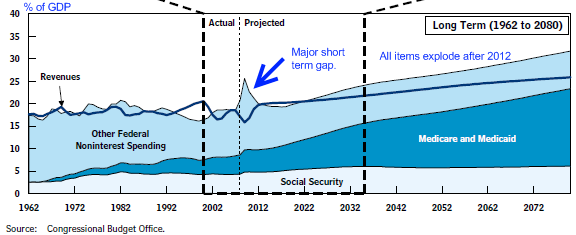
Let us take a look at the projections as put out by the CBO:

government-spending

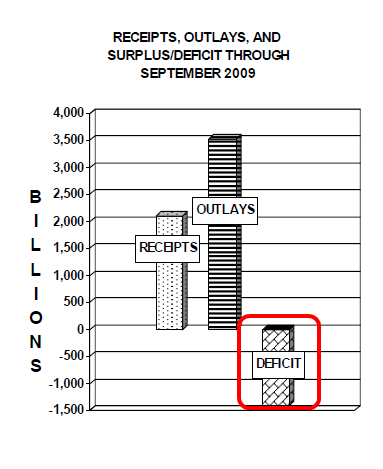
Notice that quick spike in “Other Federal Noninterst Spending” which shows the current bailout programs and fiscal stimulus. Largest spike in government spending on the chart so this should tell you the magnitude of the current recession. It is also the case that revenues are falling rapidly and that trend has not reversed. Spending is up and tax collections are down. You can tell that after 2012, the entitlement programs are going to grow at an exponential rate. We really aren’t dealing with these issues currently. At the moment all measures are focused on that blip on the chart in attempting to stabilize the economy.

I agree that the economy needs stabilization. But bailing out the banking industry with $12 trillion in explicit back stops was not the way. The FDIC has a reserve fund that is at zero and it backs up over $9 trillion in deposits. Is it smart to give this industry the right to $12 trillion in taxpayer money when clearly the CBO shows other important expenditures? Probably covering the savings of depositors is fine but this is a minor issues. Did we need to convert Goldman Sachs and Morgan Stanley into banks with easy access to the Federal Reserve? The bailouts focused on toxic debt like residential mortgages and the coming $3 trillion in commercial real estate problems.

From the chart above, it is also clear that the CBO expects income to shoot back up rather quickly and once again regain a steady course for the next 5 decades. Clearly these are rough estimates. Let us look at the latest balance sheet report from the U.S. Treasury:

income-vs-spending

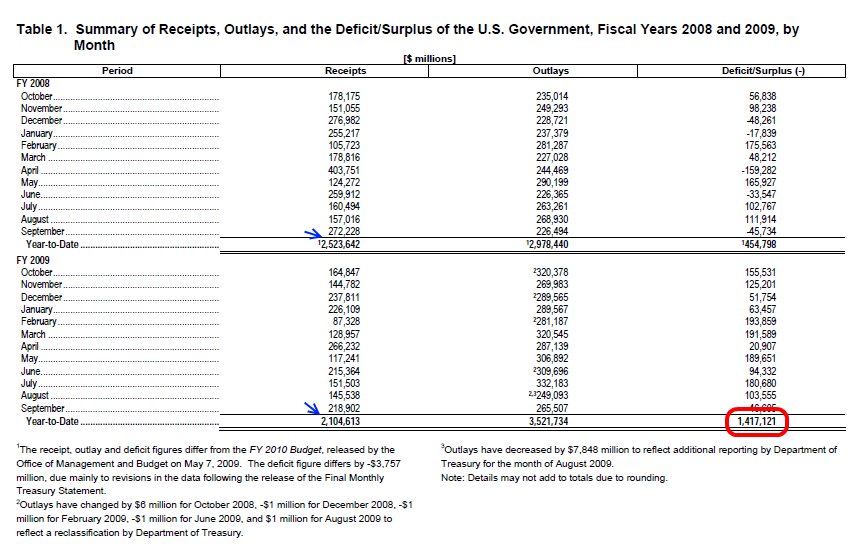
In other words, we are spending a gigantic sum more than we are bringing in. Now this isn’t something new for us. We have been doing this for years. Yet the magnitude of the current spending is enormous. If we really want to get a sense of the actual revenues and spending let us look at the U.S. Treasury monthly report:

income-sheet

This is where the big recovery talk is lost on many. Last year in 2008, September was a horrible month for us. The entire year was troubling but September was a tipping point. With that said, the government managed to pull in $272 billion from U.S. taxpayers.

Now with the supposed recovery and all the bailouts, how did the government do in September of 2009? The government pulled in $218 billion or a year over year decrease of approximately 20 percent. This is enormous. Yet when we are hearing about all these record banking profits clearly the money isn’t going back to the government even though taxpayers bailed out these institutions. This is a major recession and the balance sheet of the government reflects this. ....

Along With Layoffs, Recession’s Cost Can Be Seen in Pay Cuts - NYTimes.com

Along With Layoffs, Recession’s Cost Can Be Seen in Pay Cuts - NYTimes.com
...

The demotion, the loss of command, the cut in pay to less than his wife, Tracy, makes as a fourth-grade teacher, have diminished Mr. Lawlor, 34, in his own eyes. He still thinks he will return to being the family’s principal breadwinner, although as the months pass he worries more. “I don’t want to be a 50-year-old pilot earning $40,000 a year,” he said, adding that his wife does not want to be married to a pilot with so little earning power.

In recent decades, layoffs were the standard procedure for shrinking labor costs. Reducing the wages of those who remained on the job was considered demoralizing and risky: the best workers would jump to another employer. But now pay cuts, sometimes the result of downgrades in rank or shortened workweeks, are occurring more frequently than at any time since the Great Depression.

State workers in Georgia are taking home smaller paychecks. So are the tens of thousands of employees in California’s public university system. The steel company Nucor and the technology giant Hewlett-Packard have embraced the practice. So have several airlines and many small businesses.

The Bureau of Labor Statistics does not track pay cuts, but it suggests they are reflected in the steep decline of another statistic: total weekly pay for production workers, pilots among them, representing 80 percent of the work force. That index had fallen for 10 consecutive months before rising in July and August, an unprecedented string over the 44 years the bureau has calculated weekly pay, capturing the large number of people out of work, those working fewer hours and those whose wages have been cut. The old record was a two-month decline, during the 1981-1982 recession.

“What this means,” said Thomas J. Nardone, an assistant commissioner at the bureau, “is that the amount of money people are paid has taken a big hit; not just those who have lost their jobs, but those who are still employed.” ....

CounterPunch: Tells the Facts, Names the Names

All the Populism Money Can Buy ... By ALEXANDER COCKBURN

... Left and liberal commentators have talked yearningly about a new populist fever raging in the American body politic, prompted by the spectacle of bailouts for bankers but foreclosures and the dole for everyone else. I can’t say there’s much sign of populism in any energetic form. ...
...
... Over the weekend, the liberal opinion makers at the New York Times – Bob Herbert and Frank Rich – chewed out Goldman Sachs. Growled Herbert:

“Even as tens of millions of working Americans are struggling to hang onto their jobs and keep a roof over their families’ heads, the wise guys on Wall Street are licking their fat-cat chops over yet another round of obscene multibillion-dollar bonuses – this time thanks to the bailout billions that were sent their way by Uncle Sam, with very little in the way of strings attached.”

The Obama administration promptly rushed to cover its left flank by announcing it’s planning to impose cuts in executive pay at seven companies with substantial bailout funds. The U.S. senate’s parlor populist, Bernie Sanders, dutifully proclaimed that the Obama administration deserve praise for “taking an important step forward in trying to control the obscene compensation packages of the top executives on Wall Street.”

Note the meek qualifier, “trying.” The truth of the matter is that the Obama team has managed the tricky shot of giving more bailout money to the banks than the cumulative dispensations of all previous U.S. governments, while at the same time NOT giving any significant debt relief to ruined homeowners, a huge slice of whom is poor, black and Hispanic. Obama is not seeking to reform the financial system, and it would be beyond miraculous if he did, since the contrivers of the present mess – Lawrence Summers, et al – were given a welcoming clap on the back by the new president, as he stepped into the White House and told them to get on with the job. This amazing bailout for the existing corrupt system – as if Lenin had used the October revolution to restore the Romanovs – has been engineered without significant opposition from organized labor or the left-ßliberal end of Obama’s own party.

Of course, people curse the bankers and their political flunkeys as they watch their 10Ks atomize, their homes go, and their jobs disappear to China. They smolder as they watch the parade of Murdoch’s demagogues on Fox, flirting and toying with the theme of Obama’s assassination. ...

Sunday, October 25, 2009

Krugman Says China Is Devaluing Its Currency, ‘Stealing’ Jobs - Bloomberg.com

Krugman Says China Is Devaluing Its Currency, ‘Stealing’ Jobs - Bloomberg.com
...

By pursuing a weak-currency policy, China is siphoning demand away from other nations including poor countries, Krugman wrote in an article titled “The Chinese Disconnect” in the New York Times.

“In normal times, I’d be among the first to reject claims that China is stealing other peoples’ jobs, but right now it’s the simple truth,” the Princeton University professor said.

U.S. officials have been “extremely cautious” about confronting China on the issue, an approach that “makes little sense,” he said.

...

The U.S. economy would benefit if China began selling its “dollar hoard,” which Krugman says is currently worth about $2.1 trillion, because it would make American exports more competitive.

“With the world economy still in a precarious state, beggar-thy-neighbor policies by major players can’t be tolerated,” Krugman said. “Something must be done about China’s currency.” ...

Harold Meyerson - Where are the free-market champions? Not on Wall Street. - washingtonpost.com

Harold Meyerson - Where are the free-market champions? Not on Wall Street. - washingtonpost.com

As everybody knows, the two biggest battles on Capitol Hill -- reforming health care and regulating Wall Street -- have unleashed massive campaigns from the enemies of free markets.

The Obama administration and congressional liberals, right? Guess again.

It's health insurers and big banks that are fighting against having their products displayed on open markets, where buyers might be able to find better (and more comprehensible) deals, or are resisting reforms that would open those markets to more competition. Neither the health-care industry nor Wall Street banking is a notably competitive sector these days. Indeed, both are becoming less competitive. And they want to keep things that way.

In more than 30 states, five or fewer health insurance companies control three-quarters of the market (in Alabama, one company controls 90 percent). And mergers among health insurers are at an all-time high this year, the Wall Street Journal reported Tuesday. Worse yet, more and more businesses are declining to offer health insurance to employees (60 percent offered benefits this year, down from 69 percent in 2000 and 63 percent last year, according to an annual Kaiser Family Foundation study). Increasingly, individuals will have to shop for insurance in markets that are steadily less competitive. ...

... Over the past two weeks, one major poll after another has shown that the public supports the public option by a wide margin. Does that mean that three out of five Americans, Barack Obama and most congressional Democrats are really closet socialists? Probably not. It means that they support consumer choice, informed shopping and genuine competition in the health-care sector. The leading opponent of which is our health insurance industry, which does just fine without them.

A similar dynamic characterizes congressional efforts to regulate Wall Street. Last week the House Financial Services Committee took up the question of regulating derivatives. It crafted a bill that would enable the five banks with 95 percent of all U.S.-bank derivative holdings (J.P. Morgan Chase, Goldman Sachs, Bank of America, Morgan Stanley and Citigroup) to keep much of their business off the exchange the Obama administration proposed establishing so that investors buying derivatives could compare the prices and risks of the offerings and regulators could know when these deals threatened to topple the economy (as they did last year). By keeping these products off an exchange, the banks can (and do) collect considerable fees every time they sell such offerings -- fees that would decline if deals closed on a competitive exchange.

These fees contribute heftily to the mammoth quarterly profits that Goldman and J.P. Morgan announced this month. It's not as if banks are profiting from deals that are jump-starting the real economy, after all. They're not raking in dough from funding the next Google or Apple: A report from the National Venture Capital Association and PricewaterhouseCoopers forecast venture capital investments this year at $15 billion to $20 billion, down from $30 billion in each of the past two years.

So whence their profits? Partly, they're a consequence of the increasing concentration of finance. The profitable big banks -- chiefly, J.P. Morgan and Goldman -- "are able to charge more for all kinds of services because companies need banks and investment banks now, and there are fewer strong ones to help them," Douglas Elliott of the Brookings Institution recently told the New York Times. David Viniar, Goldman's chief financial officer, recently admitted as much. ...

Thursday, October 22, 2009

Can The Economy Recover?������� : Information Clearing House - ICH

Can The Economy Recover? :Information Clearing House - ICH: " By Paul Craig Roberts

July 15, 2009 'Information Clearing House' -- -There is no economy left to recover. The US manufacturing economy was lost to offshoring and free trade ideology. It was replaced by a mythical “New Economy.”

The “New Economy” was based on services. Its artificial life was fed by the Federal Reserve’s artificially low interest rates, which produced a real estate bubble, and by “free market” financial deregulation, which unleashed financial gangsters to new heights of debt leverage and fraudulent financial products.

The real economy was traded away for a make-believe economy. When the make-believe economy collapsed, Americans’ wealth in their real estate, pensions, and savings collapsed dramatically while their jobs disappeared.

The debt economy caused Americans to leverage their assets. They refinanced their homes and spent the equity. They maxed out numerous credit cards. They worked as many jobs as they could find. Debt expansion and multiple family incomes kept the economy going.

And now suddenly Americans can’t borrow in order to spend. They are over their heads in debt. Jobs are disappearing. America’s consumer economy, approximately 70% of GDP, is dead. Those Americans who still have jobs are saving against the prospect of job loss. Millions are homeless. Some have moved in with family and friends; others are living in tent cities. ...

Wednesday, October 21, 2009

marmar's Journal - Salon: That sound you hear is the social fabric about to snap (Real unemployment almost 20 %)

marmar's Journal - Salon: That sound you hear is the social fabric about to snap (Real unemployment almost 20 %)

Oct. 19, 2009 | According to official statistics, the unemployment rate in the United States is now 9.8 percent. But those statistics understate the severity of the jobs crisis. The official statistics do not include the 875,000 Americans who have given up looking for work, even though they want jobs. When these "marginally attached" workers and part-time workers are added to the officially unemployed, the result, according to another, broader governement measure of unemployment known as "U-6," is shocking. The United States has an unemployment rate of 17 percent.
...

2009 US economy: largest transfer of wealth to financial/political elite in global history

2009 US economy: largest transfer of wealth to financial/political elite in global history

Political “leadership” of the two oligarchy parties spin their economic policy as being for the public benefit. Professional economists increasingly cast economic policy in unprecedented harsh criticism, even calling for public demonstrations against what they claim as gross violations of financial law. Let’s consider current facts of high importance:

• Transfer of somewhere over $3 trillion with a total potential of $23.7 trillion to banks and financial institutions for the socialization of their gambling losses on illegal sub-prime mortgages and credit default swaps. We know the sub-prime lending was illegal because the FBI concluded 80% of all sub-prime fraud originated from the lenders.
• A so-called bailout designed to give money to the banksters without accountability of where the money is going. This is according to testimony of Elizabeth Warren, Harvard law professor appointed to oversee the bailout for Congress, with video explanation below. The bankster-bailout was chosen rather than simply protecting depositors and reorganizing the banks under standard bankruptcy procedure. The two oligarchy political parties denied Congressional hearings for the bankster-bailout, which should have considered cost-benefit analysis for public banks rather than private banks. An important fact that would have come out of the hearings is that the total market capitalization of all the major US banks was less than $300 billion; meaning that the government could have outright bought all of them for less than a tenth of the amount given away. Think about that.
• A 2009 record payout to bank employees, including lucrative bonuses, on pace for $140 billion.
Depression-level unemployment, with the government’s “official figures” understating true unemployment by half.
100,000 laid-off teachers with class sizes expanding to over 40 students per class, and over a million homeless US students. ...

Tuesday, October 20, 2009

OpEdNews - Article: US Joins Ranks of Failed States

OpEdNews - Article: US Joins Ranks of Failed States

The US has every characteristic of a failed state.

The US government's current operating budget is dependent on foreign financing and money creation.

Too politically weak to be able to advance its interests through diplomacy, the US relies on terrorism and military aggression. See here and here.

Costs are out of control, and priorities are skewed in the interest of rich organized interest groups at the expense of the vast majority of citizens. For example, war at all cost, which enriches the armaments industry, the officer corps and the financial firms that handle the war's financing, takes precedence over the needs of American citizens. There is no money to provide the uninsured with health care, but Pentagon officials have told the Defense Appropriations Subcommittee in the House that every gallon of gasoline delivered to US troops in Afghanistan costs American taxpayers $400.
...
Republicans and Democrats on the take from the private insurance companies maintain that the US cannot afford to provide Americans with health care and that cuts must be made even in Social Security and Medicare. So how can the US afford bankrupting wars, much less totally pointless wars that serve no American interest?

The enormous scale of foreign borrowing and money creation necessary to finance Washington's wars are sending the dollar to historic lows. The dollar has even experienced large declines relative to currencies of third world countries such as Botswana and Brazil. The decline in the dollar's value reduces the purchasing power of Americans' already declining incomes.

Despite the lowest level of housing starts in 64 years, the US housing market is flooded with unsold homes, and financial institutions have a huge and rising inventory of foreclosed homes not yet on the market.

Industrial production has collapsed to the level of 1999, wiping out a decade of growth in industrial output.

The enormous bank reserves created by the Federal Reserve are not finding their way into the economy. Instead, the banks are hoarding the reserves as insurance against the fraudulent derivatives that they purchased from the gangster Wall Street investment banks.

The regulatory agencies have been corrupted by private interests. Frontline reports that Alan Greenspan, Robert Rubin, and Larry Summers blocked Brooksley Born, the head of the Commodity Futures Trading Commission from regulating derivatives. President Obama rewarded Larry Summers for his idiocy by appointing him Director of the National Economic Council. What this means is that profits for Wall Street will continue to be leeched from the diminishing blood supply of the American economy. ...
...
... Washington is controlled by interest groups that enrich themselves at the expense of the American people.

The one percent that comprise the super rich are laughing as they say, “let them eat cake.” ...